Showing posts with label florida. Show all posts

The Sunshine State's Shadow: Threats to Government Transparency


TALLAHASSEE, FL. In recent years, Florida lawmakers have made it more difficult to enforce the Sunshine Law, which guarantees the public's right to access government meetings and records. There have been several bills passed that have limited the reach of the Sunshine Law or made it harder for the public to make sure the law is followed. For example, representatives have passed laws that make it easier for public bodies to close meetings to the public and that exempt more types of public records from disclosure.

In 2016, a bill was passed that excluded certain types of meetings from the Sunshine Law, such as meetings of the governor's cabinet and meetings of state agencies to talk about lawsuits. Then, in 2021, another bill was passed that made it tougher for the public to take legal action to enforce the Sunshine Law by making the burden of proof higher and requiring plaintiffs to pay a bond.

Another way that Florida is going after the Sunshine Law is through litigation. The state has been sued by open government advocates a number of times in recent years for violating the Sunshine Law. In 2019, the Florida Supreme Court ruled in favor of open government advocates in a case involving the governor's cabinet, finding that the cabinet had violated the Sunshine Law by holding secret meetings. However, the Legislature has also filed a number of lawsuits challenging the Sunshine Law, arguing that the law is too broad and violates the First Amendment rights of public officials.

Furthermore, the Florida Attorney General's Office has also been less aggressive in enforcing the Sunshine Law. In 2022, the Attorney General's Office filed only six Sunshine Law lawsuits, compared to 20 lawsuits in 2018.

These developments are concerning for those who believe in open government. The Sunshine Law is essential for ensuring that the public has access to information about how their government is operating. When public bodies can close meetings and withhold records, it makes it more difficult for the public to hold their government accountable.

Overall, Florida is going after the Sunshine Law in a number of ways. The state is narrowing the scope of the law through legislation and challenging the law in court in order to make it more difficult to enforce.

Here are some specific examples of how the Florida government has gone after the Sunshine Law in recent years:
  • In 2019, the governor's office tried to prevent the public from attending a meeting of the governor's cabinet by closing the doors to the meeting room and refusing to allow members of the press to enter.
  • In 2020, the state legislature passed a bill that made it more difficult for the public to sue to enforce the Sunshine Law.
  • In 2021, the state legislature passed a bill that exempted certain types of meetings from the Sunshine Law, including meetings of the governor's cabinet and meetings of state agencies to discuss litigation.
  • In 2022, the state legislature passed a bill that made it more difficult for the public to access public records by requiring public agencies to charge higher fees for copying records.
There are a number of things that can be done to protect open government in Florida. First, the Legislature should repeal the laws that have made it more difficult to enforce the Sunshine Law. Second, the Florida Supreme Court should overturn its ruling that allows public bodies to close meetings to discuss matters that are already publicly known. Third, the Florida Attorney General's Office should be more aggressive in enforcing the Sunshine Law.

Finally, the public needs to be aware of the threats to open government and be prepared to speak out against them. The public can also play a role in enforcing the Sunshine Law by filing complaints with the Florida Attorney General's Office and filing lawsuits when they believe that public bodies are violating the law.

The Controversy Surrounding Mindy Gibson: Uncovering Unethical Conduct in Satellite Beach

Vote for Mindy Gibson
"Having them speak for 3 minutes at a council meeting gives good FaceTime for them but does not accomplish much," - Mindy Gibson, September 6, 2018, via email referencing residents who attend a city council meeting to speak at the podium regarding water contamination concerns.

In a Satellite Beach council meeting in November 2022, Councilwoman Mindy Gibson falsely accused Satellite Beach resident Jeff Dubitsky and environmental advocate Stel Bailey's nonprofit organization of wrongdoing. However, Gibson's statement contradicts her previous commendation and applause for their successful work on PFAS contamination in a Brevard County Delegation meeting, which calls into question the validity of her accusation.

Gibson was involved in the 2018 closed-door meeting, where a publicly posted meeting still occurred. The meeting addressed concerns regarding contaminated water and potential cancer clusters. Police officers guarded the doorways and only allowed selected residents to attend. Video footage captured this incident, but the council members in charge were not held responsible for their actions. Gibson is the only council member remaining on the city council named in a lawsuit filed for violating sunshine law in 2018. 

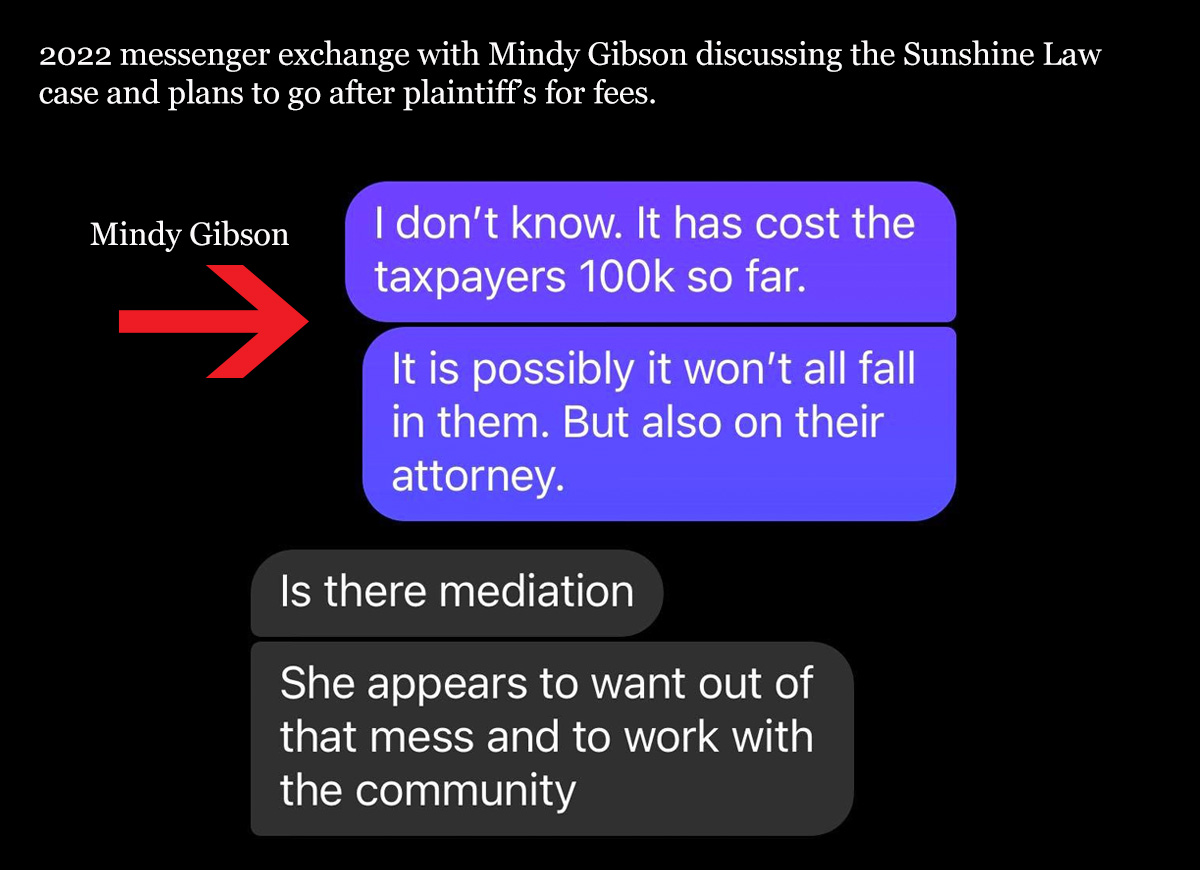
The city council members did not discuss whether they should pursue Bailey and the residents for their attorney fees. Judge Paulk dismissed the lawsuit but did not explain why. The company appealed the decision, and the appellate court upheld it while denying the city's motion for attorney fees, stating that the lawsuit was not frivolous. The city attorney announced they would continue pursuing Bailey for the costs by returning to Judge Paulk in the lower court. The decision to pursue legal fees from the residents whose civil rights were violated was made without a vote, and the city still uses taxpayers' money to prolong the legal process.

The appellate court denied fees by Judge Lambert on March 8, 2022.

City of Satellite Beach Sunshine lawsuit

Over the years, Bailey has consistently tried to establish connections with the city to find solutions for PFAS contamination, engage the South Patrick Shores community, and address health concerns in the area. We have found no evidence of any members of this organization engaging in unprofessional behavior with City of Satellite Beach government officials. Some council members have tried to create the false impression that the organization is linked to outside activists not part of the board or volunteer team. Politicians frequently use this strategy to tarnish someone's reputation through association.


Council member Mindy Gibson was recorded speaking with several individuals who were denied access to a public meeting scheduled for September 2018 outside of the Satellite Beach city hall. Despite being posted as a public meeting, it was canceled at the last minute but still proceeded. Police officers guarded the entrance doors. Gibson refused to answer questions about why only a select group of people were denied access to the meeting while others were permitted inside. 

Mark Brimer, Mindy Gibson, Frank Catino
September 17, 2018: Elected officials Mark Brimer, Mindy Gibson, and Frank Catino together behind closed doors.

Councilwoman Gibson is found discussing the case via Facebook messenger through public records suggesting that fees were well over $100,000 in February of 2022.


In previously disclosed public records, officials were observed discussing that PFAS was not a concern and contemplating ways to circumvent legal requirements for transparency. These same records also exhibited numerous email threads among city associates, urging their friend's presence at city council meetings to dispute claims made by cancer survivors and their families worried about the water.


As citizens of the United States, we have the right to hold government officials responsible for their actions. Penalizing families who seek justice will only weaken the trust within our community and discourage people from participating in civic activities.